Showing posts with label mathematics. Show all posts

19 January 2013

Book Review: Sir Cumference and the Dragon of Pi

Sir Cumference and the Dragon of Pi by Cindy Neuschwander, illustrated by Wayne Geehan
ISBN:  9781570911668

One of King Arthur's knights, Sir Cumference, is turned into a dragon and the knight's son, Radius, must find the right potion and proportion to turn his father back to human, before the dragon is killed. This children's book for grades 2-5 explains the relationship between the number pi (3.14159...), the diameter of a circle, and it's circumference.

While the writing is find, the math is find, and the illustrations are okay, I did not care for this book. It was very tightyly focused on one fact about pi and it's a fact that would lack spark to many students.  There are many other facts about pi that could have been introduced. Unlike Sir Cumference and the First Round Table, the illustrations are just there but not especially helpful at clarifying the relationship.  Additionally, the entertaining puns were sadly absent.  

This is the second in a series of children's math books by Cindy Neuschwander, called A Math Adventure.  While I had intended to buy all of six plus some of her other books, this one is making me rethink that.  I really would like to see the others before I blindly buy more.  What a pity -- could use more fun math children's books.

Book Review: Sir Cumference and the First Round Table

Sir Cumference and the First Round Table by Cindy Neuschwander, illustrated by Wayne Geehan
ISBN9781570911521


King Arthur is convening his knights for the first time, but there is a problem -- the table.  Sir Cumference takes it upon himself to solve the problem. 

This children's book helps children in grades 2-5 see the connections between various polygons and a circle. The properties of each polygon are used in the story. Mathematically it is sound and the author does explain the material in a very nice child-friendly manner. Adults will enjoy the plethora of puns. 

My only complaint is the colors in the illustrations is a bit too wild -- tone down some of the contrasts would help the appearance. ( )

As a high school math teacher, I do use this book to reinforce the properties of various polygons, because it is accurate and because even teenagers like to be read to.  I also show it to students a good example of a math book for children and then I assign them the project to make their own story book on a math topic.  While it is easy to create simple and engaging counting books for lower grades, my students begin to appreciate for much work and thought goes into presenting high school math while entertaining an audience.

06 January 2013

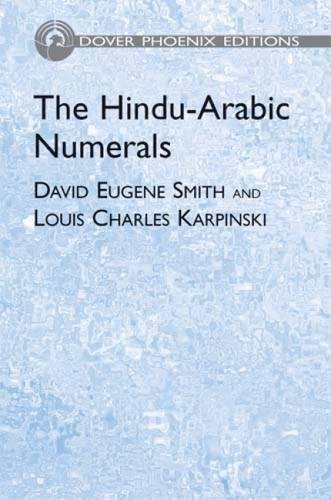
Book Review: The Hindu-Arabic Numerals

The Hindu-Arabic Numerals by David Eugene Smith and Louis Charles Karpinski
ISBN: 0-486-43913-5

The Hindu-Arabic Numerals attempts to trace the origin of our present numbers from either the Arabs, the Hindus, or the Chinese. David E. Smith collects much of the, then known, sources for the early development in a thin scholarly tome. This is a reprint of the 1911 book.

In terms of writing, the book is, as one would expect from a 19th-century educated scholar, written with care, without flowery sentences, and with appropriate footnotes. (One note -- Smith does assume a working knowledge of Latin, French, and German and is happy to quote long passages in these languages mainly in his footnotes.) Smith has included many reproductions of early numbers and references to texts, both printed and manuscript, to justify his conclusions. Anyone wishing to study the history of numbers could easily draw up a long reading list from his footnotes. This is THE book to start with, if one wants a scholarly treatment.

There were two 'problems' I had with this book. First, it was published in 1911, so much of the secondary material referred to was published in the 1890's or earlier. I do wonder what, if any, new work has been done in this field.

Second, I had assumed that this book would trace the Hindu-Arabic numerals from their origin to their present form. Smith does as good a job as can be done in defending his theory of their origin. He traces the numerals to about the 12th century and then skims over any later development. I understand that history from the 13th century onward is a bit out of his normal period, but I was hoping of a bit better treatment.

Overall, this is a great starting point for studying where the numerals we use came from. I wish I had read this several years ago! )

22 July 2011

A $1300 Trip to Borders

Today was a sad day for me.  This was the first day of the Borders Bookstore liquidation sale.  Given my general lack of income (summer, no subbing, not ready with Plan D), I suppose I shouldn't have gone to the sale, but I did.  Most of the books were 10 or 20 percent off, which is nice, but I know I could get many of them cheaper online.

Yes, I'm one of the problem people that helped Borders go bankrupt.  I buy a lot of books online.  Truthfully, I buy a lot of used books online to be exact because I do have limited funds and I do read a lot.

Still, I liked Borders.  It had a great a math section -- much better than Barnes & Noble.  I ended up buying only 4 books because of issues with funding (sounds better than I didn't have the money!).  They were:

  • The Infinite Book by John D. Barrow -- It's about the mathematical idea of infinity, including the countable variety of infinity. 
  • The Calculus Wars by Jason Socrates Bardi  -- This is a history of the development of calculus and the fight between Sir Isaac Newton and Gottfried Leibnitz over credit for the key issue.
  • Warriors Skyclan's Destiny by Erin Hunter  -- Yes, I read youth fiction, because it's about cats.
  • Warriors Bluestar's Prophecy by Erin Hunter -- ditto
I'm not sure when I  will get to start reading any of these as I have at least 3 books to read and review for various authors.  I normally read a fiction book, a math book, and a cat book, so once I finish the math book I'm currently reading, I'll start on The Calculus Wars -- it's a bit easier to read at bedtime than non-Cantorian set theory!

So, you are probably asking how these four books could total $1300?  Simple, when I was done shopping and went to start my truck, it wouldn't start.  The alarm went off (and wouldn't stop -- grr).  I finally got it started and decided I should stop on the way home to have an oil change and have them check the battery and battery cables.  

That all went well until we got to the tires.  I knew the one tire was bad because I can't keep my Ford Ranger aligned.  I didn't know it was so bad that the metal cords were showing through.  Oops!  I also did realize the other 3 tires were almost as bad.  So, add 4 tires (expensive small truck tires) and lifetime alignment to everything else.  

Grand total for the day:  $1300.  The saving grace is because I bought tires and it was over $700, I get free passes to San Diego Zoo!

I think I'll become a hermit again!